Welcome to the Nine Transformations
Communication Skills Workbook
Click here or on cover image
to download free full-book PDF.
NINE TRANSFORMATIONS FOR NEW CONVERSATIONS
INTRODUCTION and OVERVIEW :: The Nine Transformations Vision
TRANSFORMATION 1 :: AWAKEN TO, EXPLORE, & CULTIVATE the life path of conscious conversations.
TRANSFORMATION 2 :: LISTENING: Make richer and more genuine contact with your conversations partner by listening more carefully and responsively.
TRANSFORMATION 3 :: INVITING: Start new conversations by declaring your intent and inviting the consent of the other person (“the conversation before the conversation”).
TRANSFORMATION 4 :: EXPRESSING: Explore the “Five I-Messages” self-inventory as a way of both understanding yourself more deeply and then expressing yourself more clearly and completely.
TRANSFORMATION 5 :: TRANSLATING: Resolve everyday conflicts by translating criticisms and complaints into requests pointing toward positive results. Re-frame your partners-in-conflict as problem-solvers rather than problem-makers.
TRANSFORMATION 6 :: CREATIVE QUESTIONING: Explore new possibilities by asking questions more open-endedly and more creatively. “Your question is the quest you’re on.” (Sam Keen) Learn from great traditions of questioning to expand the horizons of your life and your skills at coordinating and negotiating.
TRANSFORMATION 7 :: DEVELOPING A GRATEFUL HEART: Deepen all your relationships by seeing with grateful eyes and expressing more gratitude, appreciation, encouragement and delight. The bonds of mutual appreciation help to make our relationships strong enough to hold the tensions of problem solving.
TRANSFORMATION 8 :: ALWAYS LEARNING: Shift evolutionary gears: Adopt the continuous learning stance by opening to the lesson hidden in each moment and embracing the built-in awkwardness of developing new skills — the trial-and-error nature of deep learning.
TRANSFORMATION 9 :: WIDENING THE LEARNING CIRCLES: Work together with peer partners to build wider circles of mutual support for cooperative communication skills — for both ourselves and for the wider world around us.
CHAPTER 10 :: EXPLORING THE RIGHT TO INVITE AND THE NEED TO NURTURE: Reaching Out to Advocate and Mend in a Troubled World.
Dedication
Dedicated to Marshall Rosenberg, Barnett Pearce, Ramon Panikkar, and Joanna Macy, four of my teachers, and to the creative team-builders and peacemakers in every culture and faith. Where there is a clash of wills, may we bring the light of new understanding and a meeting of hearts.
In the spirit of the teachers mentioned above, this workbook carries a Creative Commons copyright license. Anyone may republish it or make as many copies of all or parts of it as they wish. For more information about the details of this Creative Commons license, please see into at bottomof this page.
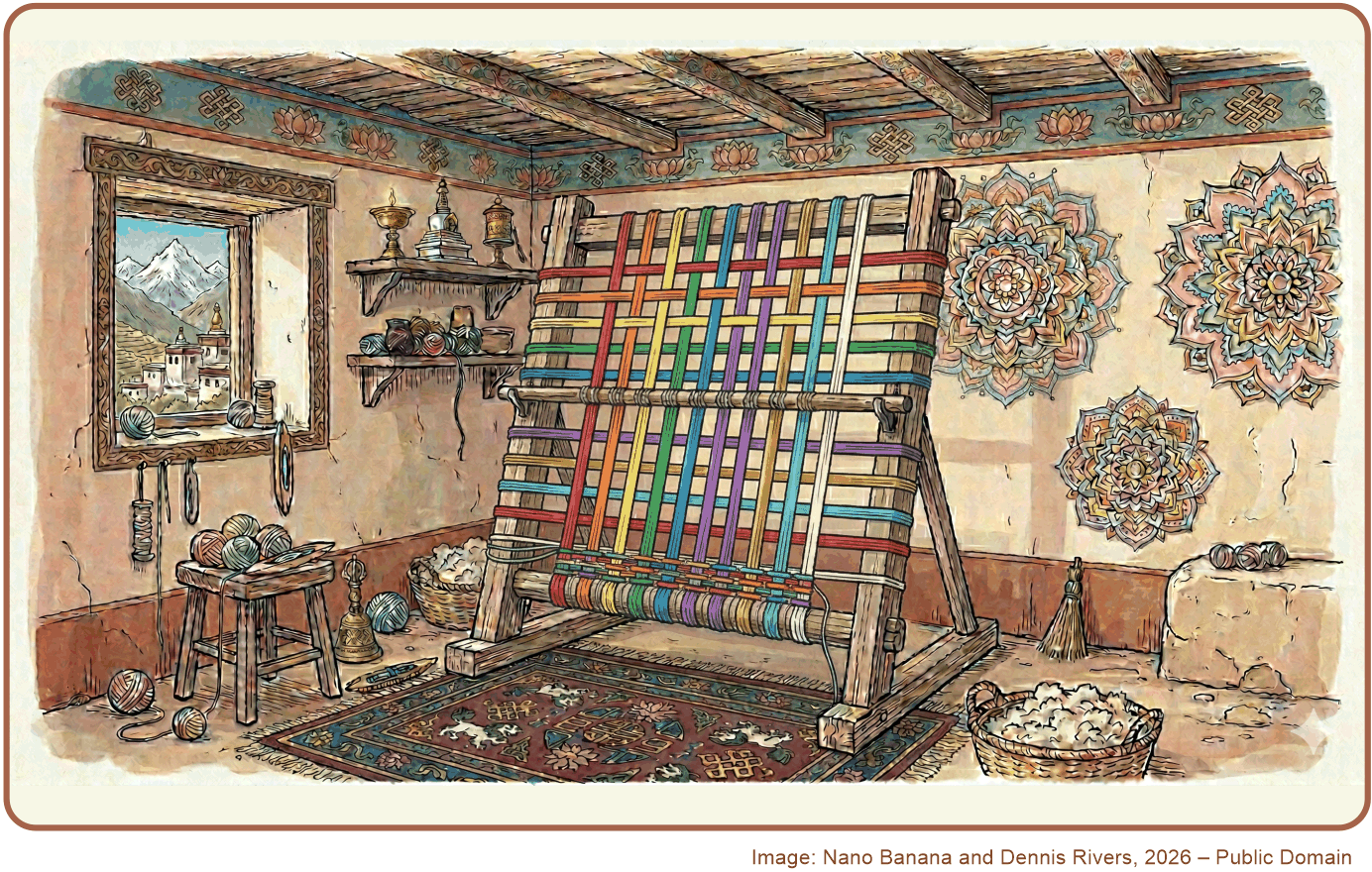
The Loom of Emergence
We weave together words to make sentences.
We weave together sentences, and listening, and turns, to make conversations.
We weave together conversations and actions to make relationships.
We weave together relationships to make families and communities.
We weave together communities to make a shared world.
Scouting the Territory Ahead

A Conversation You Already Know How to Have
Think of a conversation that went better than you expected. Perhaps someone was upset with you, and instead of firing back you asked what had happened, and the temperature of the whole room changed. Perhaps you finally said something you had been holding in for months, and the other person said, “I’m so glad you told me.” Perhaps a stranger thanked you for something small, and you carried the warmth of it for the rest of the day.
Nearly everyone has moments like these, and they are not accidents. In each one, someone — perhaps you — stepped slightly off the usual script: paused, listened, asked, invited, appreciated. This workbook is about those moments: what was happening in them, why they don’t happen more often, and how you can learn to create them on purpose.
The picture at the top of this page shows the whole journey at a glance. On the left, two people locked in a contest, each trying to win. On the right, the same two people at the same table, with an idea glowing between them that neither could have reached alone. Taken as a whole, this workbook invites you to move:
-
from conversations that happen to us, to conversations we help to shape
-
from habits we absorbed without choosing, to skills we practice by choice
-
from winning against people in a win-lose game, to succeeding together with them
-
from learning alone with a book, to growing within circles of companions
-
from changing our own conversations, to quietly changing the conversational culture around us
None of this asks you to become a different person. It asks you to become, one conversation at a time, more fully the person who showed up in those best moments — more often, and on purpose.
The Thread Through Every Chapter:
Observing Makes Guiding Possible
Every chapter in this workbook is built around a single movement, and it may help to see it plainly before we begin.
Most of what we do in conversation we learned long before we could think about it. We absorbed the conversational patterns of our families, schools, and cultures the way we absorbed our first language — by imitation, without choosing. Those patterns now run largely on autopilot. That autopilot is not a failure; it is simply unexamined. This points us toward a key feature of human development: what we want to guide more carefully in our lives, we need to start observing more carefully.
The developmental psychologist Robert Kegan, in his book The Evolving Self, described growing up as a lifelong series of steps in which something we were once completely inside of becomes something we can step back from and look at. A small child does not have anger; the child is the anger. A few years later the same child can say, “I’m mad at you!” — and a feeling that used to run the child has become something the child can notice, name, and begin to manage. Kegan’s insight is that this kind of shift does not stop in childhood. It is the basic shape of growth across a whole human life: what we were embedded in becomes what we can observe, and what we can observe becomes something we can make choices about.
That is the thread. Each of the Nine Transformations takes one area of conversation that usually runs on autopilot — how we listen, how we begin, how we express what we feel, how we complain, how we ask, where our attention goes — and invites you to turn on what I call the twin headlamps of conscious attention and conscious intention. First you notice what you have been doing. Then, gradually, you get to choose.
Many of the specific conversational practices in this workbook come from Marshall Rosenberg, the founder of Nonviolent Communication, whom I was fortunate to know and learn from. I came to understand only slowly how his work and Kegan’s fit together. Rosenberg gave me the moves; Kegan helped me see what learning those moves does to a person. Rosenberg’s very first teaching — to separate what we actually observed from the judgments we add to it — is itself one of Kegan’s steps: a judgment we were making without thinking inside becomes a judgment we can see. The skills in this book are practical ways of taking that step, again and again, in the places where it matters most.
Half the lines in every conversation? Wow!
One of the most empowering lessons I learned from Marshall Rosenberg was this: to have new conversations, we do not need to wait for the other person to change. We each have half the lines in every conversation. If someone throws a mudball at you, you do not have to pick it up and throw it back. You can offer back a flower, or a cup of coffee, or a thousand other things — because we have more creative choices than we realized.
Our conversations have deep elements of imitation woven into them. We can often be dragged by the momentum of imitation in directions we don’t want to go. But we can also guide the momentum of imitation by participating in just the way we would like to see everyone else participate. This is a very everyday application of the saying attributed to Gandhi: “Be the [conversational] change you want to see.
Becoming a person
All of the conversational signals we send out toward other people, we also “send in,” to our own hearts and minds. We carry them around inside of use for a lifetime and they become part of us. Notice how many of our most valued qualities of character describe people in conversation with other people: patient, kind, generous, helpful. These long-term adjectives of character grow out of a lifetime of moment-to-moment adverbs of conversation: listening and speaking patiently, kindly, generously, helpfully.
So every conversation, beneath its immediate purpose and content, is two more things: a step in your own development as a person, and an example-plus-invitation to the people around you. Every time you listen carefully, you make your own life easier and you teach the people around you that careful listening is possible. Every time you turn a complaint into a clear request, you arrange a better outcome for yourself and show others a better way of getting their needs met.

Every conversation sends out invitations to talk and listen in that particular way.
The Nine Transformations at a Glance
Summary of Transformation One: AWAKENING
(click here for PDF of full chapter)
Seeing with New Eyes:
Awakening to and Embracing Conscious Conversations
From communicating on autopilot to communicating on purpose.
You already know how to master something complex. You learned to walk through months of wobbling, a long episode of focused attention that you no longer remember. This chapter invites you to bring that same attention to how you talk and listen. It offers five starting points: why communication matters so much, why we are born ready to learn rather than already equipped, the three-sided balancing act every group must manage, why lasting change needs companions, and how each of us is already a communication trainer by example.
What becomes visible: the conversational habits you absorbed without choosing.
What is unfolding at the becoming-a-person level:
Seeing yourself as a developing communicator rather than a finished one.
Once you can see your own patterns, the natural first place to practice is the half of every conversation that is usually least conscious: listening.
Summary of Transformation Two: LISTENING
(click here to jump to chapter)
Connect Better With Your Conversation Partners
by Listening More Carefully and Responsively
From waiting for your turn to talk, to genuinely wanting to understand.
Most of us know what it feels like to be truly listened to, and we have offered that gift ourselves more often than we realize. This chapter shows how to make it a practice. Listen first, and briefly restate what you heard — especially the feelings — before expressing your own view. What makes this possible is separating acknowledging from agreeing. You can show someone you understand them without approving of or agrreing with what they are sharing, or promising to do what they ask.
What becomes visible: Your own urge to defend or reply, and the other person’s experience as it actually is for them.
What is unfolding at the becoming-a-person level:
Meeting perspectives and experiences very different from your own while staying centered in your own values and sense of self.
Listening helps you receive a conversation well. The next question is how to begin one well.
Summary of Transformation Three: INVITING
(click here to jump to chapter)
Start New Conversations by Explaining Your Conversational Intent
and Inviting Consent
From launching into conversations to inviting people into them.
Many good communicators already do this by instinct. Before an important conversation, they say what they would like to talk about and ask whether this is a good time: “I’d like to talk with you for a few minutes about the budget. When would work for you?” This small conversation before the conversation turns ambushes into appointments and gives the other person the big picture. It also treats their participation as a gift rather than an obligation. The chapter explores the wide range of conversations you might invite someone into, and some intentions worth leaving behind.
What becomes visible: Your own intentions for a conversation, which usually go unspoken even to yourself.
What is unfolding at the becoming-a-person level:
Gradually giving up intentions to injure, demean, or punish, and treating others as consenting equals.
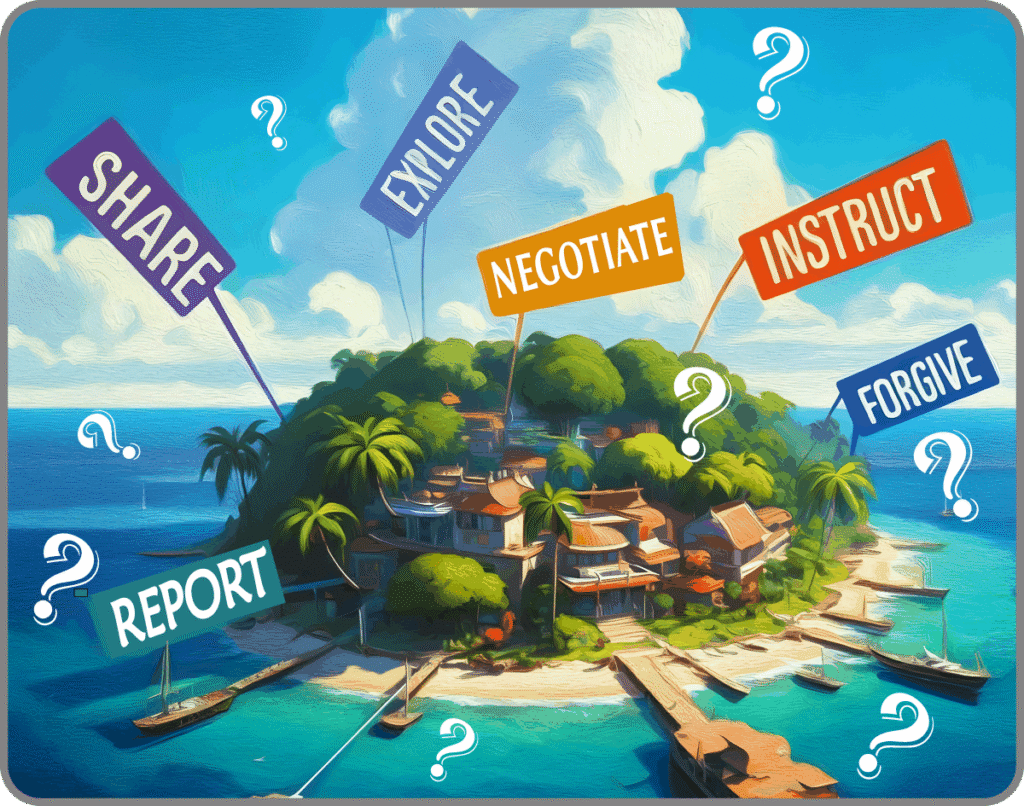
Where do you want to go on Conversation Island?
Once a conversation has begun, the next challenge is saying what you actually mean.
Summary of Transformation Four: EXPRESSING
(click here to jump to chapter)
Filling in the Missing Information with the “Five I-Messages”:
Understanding and Expressing Yourself More Clearly and Completely
From speaking in shorthand to saying more of what you mean.
We usually share only a few fragments of our experience and expect our listeners to fill in the rest. The Five I-Messages are a map for looking inward before speaking outward. What am I sensing? What am I feeling? What interpretations and wants lie under those feelings? What am I asking for? And what good result would that lead to? The more of these you can find in yourself and put into words, the easier it becomes for others to understand you and respond with care.
What becomes visible: The separate layers of your own experience — what you observed, what you felt, and what you concluded — which usually arrive fused together.
What is unfolding at the becoming-a-person level:
Telling more of the truth, growing beyond blaming, and making friends with feelings, your own and other people’s.
Clearer self-expression opens the way to one of its most practical uses: turning everyday frustration into a request someone can actually say yes to.
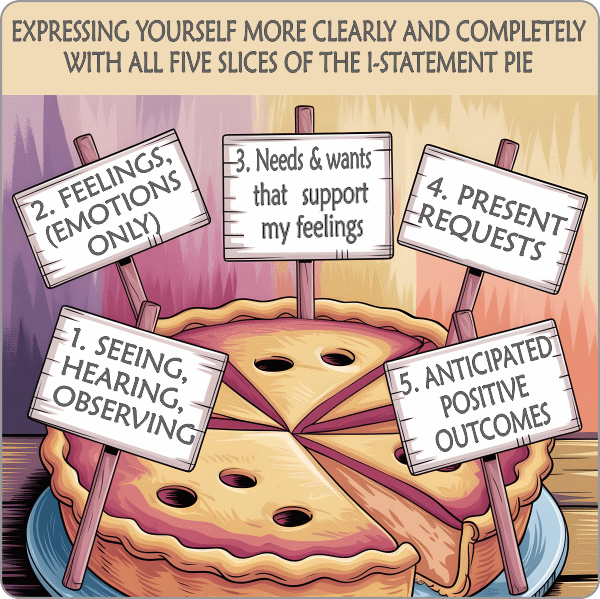
Clearer self-expression opens the way to one of its most practical uses: turning everyday frustration into a request someone can actually say yes to.
Summary of Transformation Five: TRANSLATING
(click here to jump to chapter)
Resolving Everyday Conflicts by Translating Criticisms and Complaints
into Specific, Success-focused Requests
From criticizing what went wrong to asking for what would go right.
Every complaint contains a hidden request. This chapter offers a quick tool for everyday friction: ask for a specific action, using verbs rather than labels, and explain the good result it would bring. “You’re so lazy” becomes “Would you be willing to take out the recycling on Tuesday nights, so it doesn’t pile up on the back porch?” The same skill works in reverse. When others criticize you, you can translate their complaint into the request it contains. Requests cast people as problem-solvers rather than problem-makers.
What becomes visible: The unmet need hiding inside a complaint, yours or someone else’s.
What is unfolding at the becoming-a-person level:
A sense of self-worth strong enough to accept being turned down, and the imagination to find solutions in which everyone gets at least some of what they need.
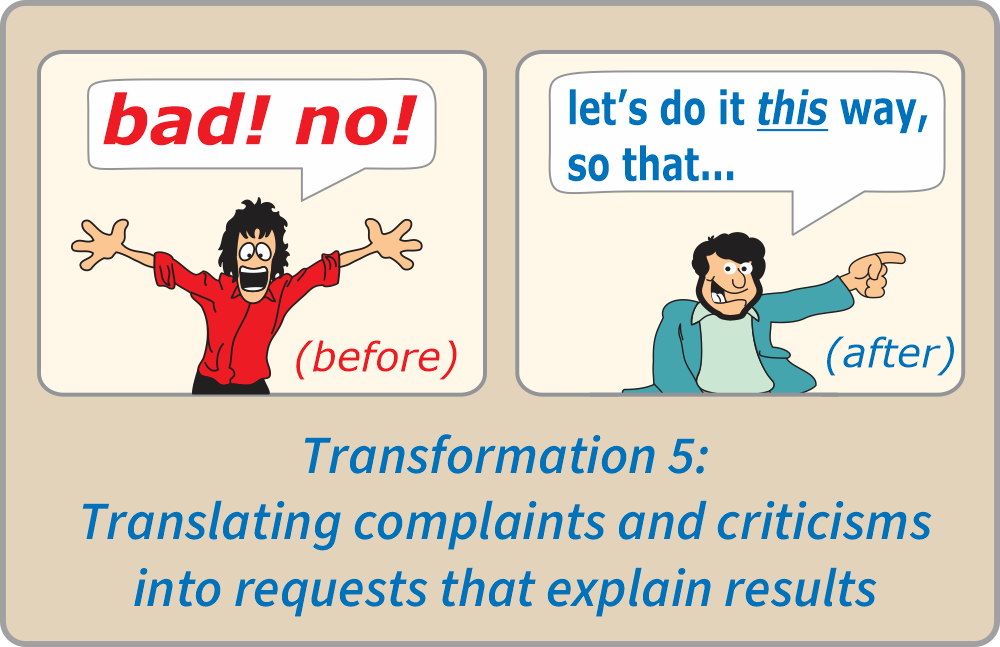
Requests ask for action. Questions open the way to discovering what else might be possible.
Summary of Transformation Six: CREATIVE QUESTIONING
(click here to jump to chapter)
Move Your Conversations Forward
by Asking Questions More Open-endedly and Creatively
From questions that close people down to questions that open them up.

Open-ended questions
open up new
possibilities.
“How did you feel about that meeting?” invites a far more detailed response than “Did you like it?” This chapter begins with open-ended questions and then widens into ten families of questions drawn from many traditions. Some ground you in what you are actually feeling. Some find what is already working. Some help a group move from problem-saturated thinking toward possibility thinking. As the writer Sam Keen put it, your questions are the quest you’re on.
What becomes visible: The assumptions built into the questions you habitually ask.
What is unfolding at the becoming-a-person level:
The courage to hear a wide range of answers, and staying in balance as you encounter needs, views, and tastes different from your own.
Questions that look for what is already working lead naturally to the practice of noticing it out loud.
Summary of Transformation Seven: DEVELOPING A GRATEFUL HEART
(click here to jump to chapter)
Deepen All Your Relationships by Expressing More Gratitude,
Appreciation, Encouragement & Delight
From noticing only what’s broken to seeing what is wonderfully together.

Hand over heart —
universal gesture
of gratitude
Life constantly asks us to attend to problems, so it becomes easy to see only what needs fixing. This chapter explores four “heart beams” — gratitude, appreciation, encouragement, and delight — as distinct ways of noticing what is good and saying so. It also offers a simple three-part structure for appreciations that truly land. Thinkers and researchers in several fields agree that a core of mutual appreciation is what makes a relationship strong enough to hold its every-now-and-then disagreements.
What becomes visible: Where your attention habitually goes, and what it passes over. The Yes/No balance in your life.
What is unfolding at the becoming-a-person level:
Shifting your whole orientation toward gratitude — toward other people, toward the challenges you face, toward nature, and toward life itself.
Now, with some familiarity with the first seven transformations in this workbook, the question becomes how to deepen our practice and extend our reach. That leads us to the last three chapters.
Transformation Eight: ALWAYS LEARNING
(click here to jump to chapter)
Shift Evolutionary Gears by Adopting the Continuous Learning Stance
From “I’m just not good at this” to “I haven’t learned this yet — and I’m going to.”

Spiral Shell —
Organic Symbol
of Continuing Development
If you have been practicing the earlier chapters, you have already been living this stance without a name for it. Here it gets its name. The chapter explores how to catch fixed-mindset thinking in the act, and why self-forgiveness is learning’s necessary partner. It also shows how your brain’s habit system, so often treated as the enemy of change, can become your ally when you practice new skills in many different situations.
What becomes visible: Your own learning process, and your attitudes toward it, so that growth itself becomes something you can guide.
What is unfolding at the becoming-a-person level:
The lifelong awareness development mapped by psychologist Robert Kegan, applied to our conversations: From being immersed in our patterns and not seeing them, to observing and guiding them — the theme of this whole workbook — now becoming part of your own life story.
This kind of inner change is hard to sustain alone, which is why the next chapter turns outward toward learning companions.
Summary of Transformation Nine: WIDENING THE LEARNING CIRCLES
(click here to jump to chapter)
Grow Wider Circles of Mutual Support with
Practice Partners, Circles of Six, and Cooperative Networks
From learning alone to growing together.
All these new communication skills are going to be applied in actual relationships, so they are best explored and practiced with real people. This chapter offers practical guidance for forming a Purpose Partnership with one other person, and then a small Circle of Six for co-learning, including a working agreement you can adapt. It also offers resources for times when no partner is yet available, such as the circle of empowering ancestors whose example we can carry with us.
What becomes visible: The very familiar culture of isolated effort — and the possibility of creating a cooperative community that will shape new ones.
What is unfolding at the becoming-a-person level:
Creating islands of cooperation and mutual support that can widen to include more of the people you meet.

Ancient Circles of Support — Art by Edward Hallam
Used with permission via 123rf.com.
Circles of practice raise one more question: what does it mean to carry these skills into a world that is often anything but cooperative?
Summary of Chapter Ten — THE WIDENING HORIZON
(click here to jump to chapter)
Exploring the Right to Invite and the Need to Nurture:
Reaching Out to Advocate and Mend in a Troubled World
From practicing in sheltered safety to planting seeds in a troubled world.
The final chapter acknowledges the world as it actually is in many places: often violent and fearful. It argues that in a densely interwoven world, the right of self-defense must include the right to advocate peaceful conflict resolution and everyday compassionate communication. And it invites you to become a Joanna or Johnny Appleseed of cooperative communication. Not a missionary who arrives as a superior with a criticism, not a TV guru offering expensive help, but a fellow citizen searching for a better way and inviting everyone to join the search.
What becomes visible: The culture of perpetual conflict around us, no longer as a fixed fate, but instead as something we can help to change.
What is unfolding at the becoming-a-person level:
Trusting that the seeds travel further than the planter. You do not have to see the harvest to justify the planting.
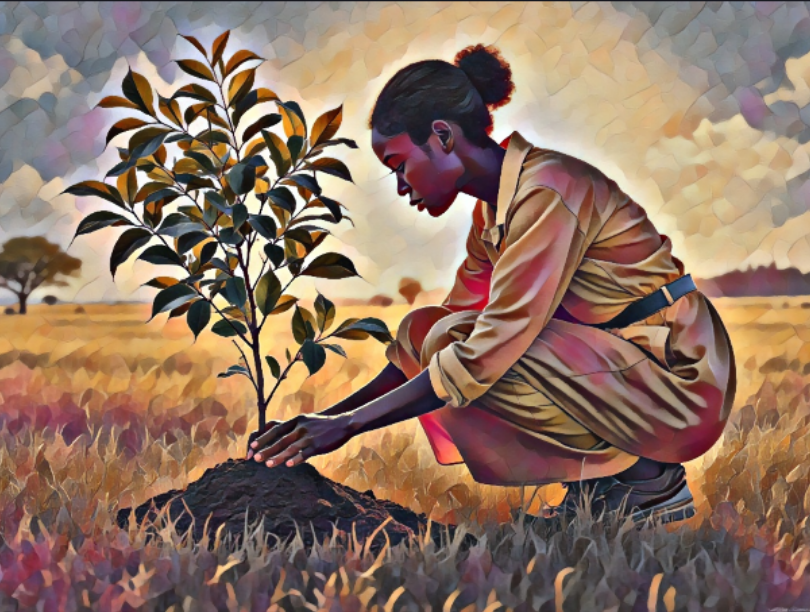
The Tree Planters — Image in memory of Wangari Maatthai
and in honor of the Greenbelt Movement — Public Domain AI image
How to Use This Workbook
There is no single right way through these pages. Here are four common paths:
-
Straight through. Read the chapters in order, practicing each transformation for a while before moving on. This lets each skill prepare the ground for the next.
-
Start where it matters most. If one transformation speaks directly to a difficulty in your life right now, begin there. Each chapter stands on its own, and its Spiral section will show you how it connects to the rest.
-
With a partner. Find one other person to read and practice with. Transformation Nine explains how, step by step, but you can begin at any time.
-
As a class or group. Teachers and group leaders often use single chapters as separate study documents. Each chapter has its own summary, examples, exercises, and suggested readings, so it can be used on its own.
Most chapters follow a similar pattern. They open with a list of “from–to” shifts, recognize a capacity you already have, show the skill in practice, explain why it works, connect it to the other transformations, and close with exercises and readings for going further.
A word about awkwardness. New conversational skills almost always feel clumsy at first. That clumsiness is not a sign that you are doing it wrong. It is the normal feel of a capacity stretching beyond its familiar range — the same wobble you once felt learning to walk, ride a bicycle, or drive a car. Each chapter breaks its requests into steps small enough to actually do, and you will find that fluency arrives faster than you expect.
Finally, consider coming back to this overview after you reach Transformation Eight. The map will look different once you have walked some of the territory, and you may find that ideas which seemed abstract at the start now feel like descriptions of your own experience.
A First Step
Before you turn the page, take a few minutes with one question. Think of the two or three people whose conversations with you matter most. For each one, write down a conversation you would like to go differently — or one that already goes well and that you would love to have more often.
Write it anywhere: a notebook, a digital document, even an email to yourself. That small act of writing is the first use of the twin headlamps, because seeing your conversations on the page lets you look at them from a new angle. It also gives you a question to carry into the chapters ahead, so that each one has something real to answer.
Transformation One will help you turn this first note into a Learning Journal, and will invite you to begin keeping an eye out for a practice partner. For now, this one entry is enough. Welcome to the journey.
CREATIVE COMMONS COPYRIGHTS AND PERMISSIONS:
(the gist) YOU HAVE PERMISSION TO MAKE COPIES
AND TRANSLATIONS OF ALL OR PARTS OF THIS WORKBOOK
For non-profit distribution: You have non-exclusive permission to make an unlimited number of copies and/or translations of this entire workbook (or parts thereof written by Dennis Rivers) for use in your family, school, college or university, business, public agency, church, synagogue, mosque, temple, and/or community service organization, provided that such copies include this permissions page (or in the case of sections or pages, include one of the short Creative Commons copyright notices described below)
For general distribution (including course readers in schools and colleges): The pages and documents appearing in Nine Transformations for New Conversations are copyright 1997 through 2026 by Dennis Rivers, except where otherwise noted or where excerpts from already copyrighted scholarly works have been cited in accordance the “Fair Use” doctrine of copyright law. The parts of this workbook written by Dennis Rivers may be copied, adapted, translated, distributed and/or sold in book or sheet format, under the terms of the “CC BY-SA 4.0 Attribution-ShareAlike 4.0 International Deed” which you can read at https://creativecommons.org/licenses/by-sa/4.0/deed.en . This License provides that any such copies, editions, translations, and/or adaptations bear the license shown below, allowing others to reproduce and further develop the work adapted. The parts of this workbook written by authors other than Dennis Rivers retain their original copyright and cannot be sold to the general public or incorporated into new works for sale without the permission of their respective authors.
Please include the following at the end of any multiple-page copies of material written by Dennis Rivers:
In all countries allowing Creative Commons free-to-copy licenses:
“Copyright 1997-2026 by Dennis Rivers. Reproduced with author’s permission from the original at Communication-Skills.NET under the CC BY-SA 4.0 Attribution-ShareAlike 4.0 International Deed” which you can read at https://creativecommons.org/licenses/by-sa/4.0/deed.en”
Please note individually reproduced pages that are written by Dennis Rivers as “Copyright 1997-2026 by Dennis Rivers. Reproduced with author’s permission under Creative Commons license CC BY-SA 4.0.”
In all countries not recognizing Creative Commons free-to-copy licenses:
“Copyright 1997-2028 by Dennis Rivers. Non-exclusive permission to reproduce for educational, community, organizational and commercial use granted by author.”
May all your efforts to create more cooperative families, workplaces and communities be blessed with success. (This workbook is available as a series of free web pages and PDF files at Communication-Skills.NET.)